Guardians of the Past
02 Sep 2026
Inside Legacy Architectural Salvage, a dedicated community preserves the pieces—and stories—of Wilmington’s history
Sept-Oct 2026
Written By: Larry Rubin | Images: Daria Amato
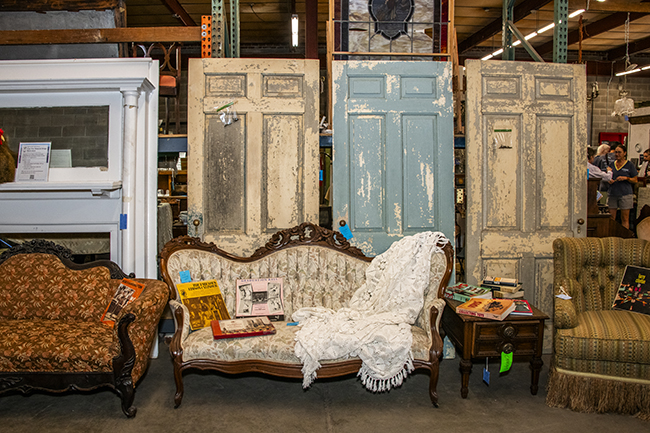
I grew up in an apartment house in Brooklyn, built back in the time when household garbage was dropped down a tiny chute in the incinerator room, a 10-by-10 chamber of mysteries for a curious and restless young boy. Objects too big or deemed too special by their owners to fit down the chute—comic books, contraptions and small pieces of furniture—were left just inside, awaiting this child who grew up to be an unapologetic dumpster diver and salvager. Little did I know that salvaging would become part of my own legacy.
The word “salvage” evokes images of objects rescued from the past: a Viking warship with its oars still intact, a long-lost Spanish galleon laden with treasure or even the Titanic. The term derives from the French “salvare,” meaning “to save,” and originally referred to recovering ships and cargo from the sea. Over time, its meaning broadened to include saving objects and property from damage, loss or destruction.
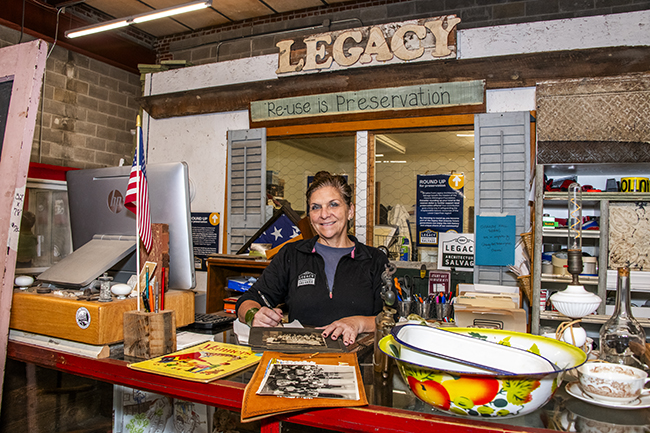
What is it about old objects and structures that can be so compelling? Is it in our collective DNA to harvest and romanticize the objects of the past for access to an era of simplicity and comfort and to the stories of those who came before us, whether ancestors or strangers? Or is recovering, protecting and preserving the objects of the past the province of “want” rather than “need”? Aren’t disposable funds often required to find, buy and refurbish a midcentury modern kitchen, a 1920s Singer sewing machine, an 1890s Edison record player, an intact set of windows from a Victorian-era antebellum home like the Latimer House, or an entire colonial-era Georgian home like the Burgwin-Wright House? These objects and places hold power over us. They transport us.
Enter Legacy Architectural Salvage
Finding your way to the mysterious warehouse home of Wilmington’s Legacy Architectural Salvage (LAS) is an adventure. As you enter through an unassuming aluminum door, you soon realize that you are not in an ordinary repository for salvaged remnants of the past. You are at an intersection between past, present and future—a place where living history meets lived-in history, where architectural odds and ends beckon as if they were gold doubloons awaiting discovery and carry the promise of old stories and new adventures. It is many things: a store, donation center, warehouse, classroom and vital part of a nonprofit organization.
If you return a few times, you will no doubt meet the guardians, historians, docents and stewards of this liminal space, the first of whom will be Kelly Hurst, its Legacy coordinator. A native North Carolinian with fond memories of his grandmother’s 19th-century home and of exploring abandoned houses with his uncle, he is quick to share, “For a Southerner, the past is never dead!” A lover of history, he explains that LAS, whose mission is to preserve and protect the architectural history of Wilmington, is owned and operated by the Historic Wilmington Foundation (HWF). He adds, “We are 100% donation-based and the best-case option—saving and rehabbing—in a worst-case scenario, when a building must be demolished or is too badly degraded or damaged.”
Kelly shared stories about Legacy’s connection to Reaves Chapel, a former Gullah Geechee church built in the second half of the 19th century, from which LAS received wonderful light fixtures and to which it provided funding through the HWF in conjunction with the Orton Foundation and Cedar Hill/West Bank Heritage Foundation. He also related the story of 18th-century Shandy Hall, from which LAS received windows and doors before its renovation. Before I continued my explorations that day, we pondered a massive wooden structural beam from Shandy Hall, studied the rings of the tree from which it was felled and concluded that it was at least three centuries older than the original building.
Next, you might encounter John Hooks, Legacy’s resource specialist, who grew up on a farm and fondly recalled visiting his parents’ antique store in Whiteville. John oversees and coordinates deconstruction. He loves telling the story of the pre-Civil War jailhouse door that LAS recovered from Whiteville. Both he and Kelly agree: “The most important thing we do is give people who come here an experience.” LAS is a veritable smorgasbord of just about anything that could be salvaged from a house or building in Wilmington or its surrounding towns, dating from the 1970s back to the colonial era.
Finally, there’s Carol Bullock, the Historic Wilmington Foundation’s recently installed executive director, who proudly explains, “LAS is one of our main revenue sources that supports our mission of preservation and advocacy.” She is inspired by “the time, effort, utility and skill that went into creating these wonderful things.” She and Kelsey Hendry, the outreach and development director who organizes the Azalea Festival Home Tour and the HWF’s social media presence, are “involved in advocacy within the community whenever there is modernization impacting the local environment, architecture and culture.” Together, along with LAS, they are, as Carol says, metaphorically “fighting off mortality” and materially preserving Wilmington’s architectural history.
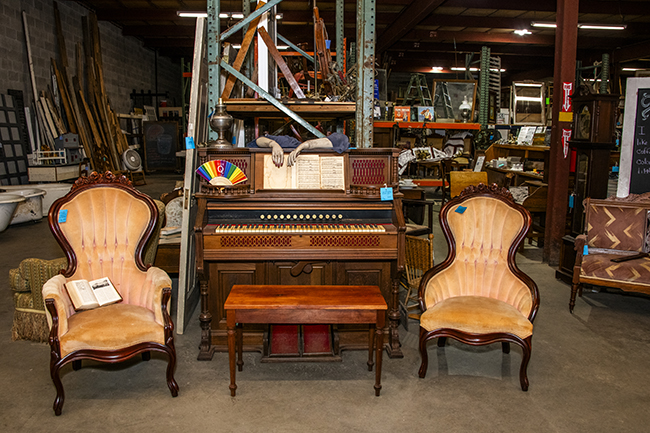
Tour Guides to the Gallery of Wonders
If every picture tells a story, imagine what a Victorian four-poster bed, a 200-year-old stained-glass church panel, an intricately hand-carved and child-inscribed oak fireplace mantel, a slab of hand-hewn African mahogany, a hundred-year-old wine bottle, a porcelain doorknob, a chamber pot, a sewing machine, a microscope or a 10-panel sash window could say. That’s where Legacy’s volunteers come in—a community of like-minded lovers of history, both architectural and cultural.
Steve, a former HWF board member, has been with LAS for eight years. He was a college forestry major and sawmiller, knows his way around tools and has an encyclopedic knowledge of wood, from pecky cypress to pine. “We preserve the irreplaceable and focus on the built history of the Cape Fear region,” he says. “We save the old buildings when possible, but when not, we take the low-hanging fruit, such as roofs, windows, doors and flooring.” He started a singing circle—on antique chairs, of course.
Terry, who has also been with LAS for eight years, has “always been into repurposing.” She helps with deconstruction, is proud of having learned about old-growth wood and confesses, “I had to control myself from buying everything in the beginning.”
Mark, another eight-year veteran, was an interior decorator. “I started stripping furniture when I was 12,” he says, but now creates art from salvaged pieces of just about anything.
Bill, with five years under his belt, wryly chimes in, “We are the best-kept secret in the Wilmington antique world because most people think we’re just about salvage. Oftentimes, kids don’t really care about their parents’ or grandparents’ stuff, so it finds its way to us.” Like his fellow volunteers, Bill loves the campy atmosphere.
Richard tells me, “Everything is donated, so people can get a tax write-off,” and humbly shares, “I’ve restored a 130-year-old Queen Anne and a Craftsman bungalow from the early 20th century.”
Ashley, who roams LAS offering all comers a ready smile and witty conversation, needed something to fill her time when her parenting responsibilities receded. She has made new friends, including Louise, LAS’ SEO (signage executive officer), who grew up in a 1950s home and dabbles in fiber art and quilting.
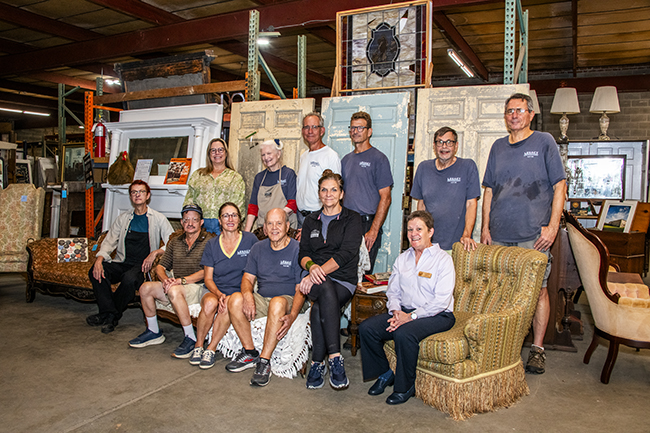
Something for Everyone
While there is clearly someone for everyone at Legacy, there is also something for just about everyone.
For the volunteers, LAS is a gathering place where their shared passion for community intersects with their love of and respect for art, culture and history.
For the casual visitor or shopper, LAS is a curiosity shop, a true multisensory experience where imagination and wonder compete with pragmatic need.
For the skilled or casual craftsperson working on anything from a simple window repair to the renovation of an inheritance or acquisition, LAS is a resource for finding the structural element needed to breathe life into a project. It is also a classroom for learning how to do so, offering a variety of hands-on classes.
For the interior or movie set designer looking for a true period piece, whether an art deco mirror, Victorian rocker or colonial-era rug, Legacy is their kind of place.
To the repurposer looking for artistic or utilitarian ways to bring together past and present, LAS offers several possibilities, including charcuterie boards made from slabs of ancient hardwood.
To the advocacy- and history-minded, LAS is a living library, a steppingstone on their journey to explore and protect the cultural, environmental and social foundations of Wilmington and its surroundings.
Finally, for children, LAS’ collaboration with the HWF’s “Tar Heels Go Walking” program gives every New Hanover County third grader the opportunity to explore the region’s architectural history.
Long ago, I searched an incinerator room for discarded treasures. At LAS, an entire community comes together to rescue treasured remnants of its discarded past. If history does not repeat itself but instead rhymes, what better place is there to experience Wilmington’s architectural poetry?
Visit the Historic Wilmington Foundation’s website for a full description of its programs, including, of course, Legacy Architectural Salvage: historicwilmington.org.