Stay Curious and Keep Creating
02 Nov 2026
Rachard McIntyre follows his interests wherever they lead, transforming history, people and places into calligrams, paintings and mixed-media art
Nov-Dec 2026
Written By: Lawrence Rubin | Images: Madeline Gray
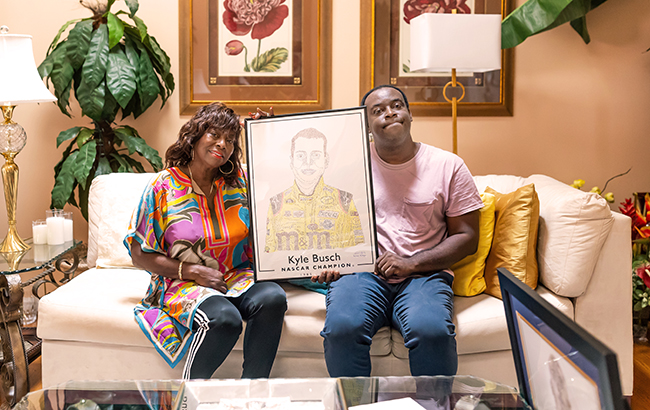
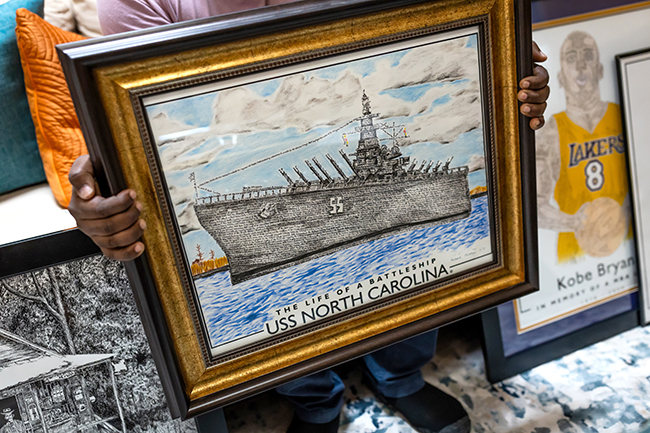
I met Rachard McIntyre in the Wilmington home he shares with his mother, Carrie. As he carefully laid out some of his favorite pieces, I was immediately drawn to meticulous, photorealistic black-and-white renderings of familiar sites such as the Battleship North Carolina and Cape Fear Community College. There were also equally compelling images of the Eiffel Tower, the Twin Towers, the RMS Titanic, the Golden Gate Bridge, Stonehenge and New York’s Art Deco masterwork, the Chrysler Building.
At first glance, the works looked like intricate pen-and-ink drawings. But Carrie invited me to move closer so I could see that each image was composed entirely of tiny handwritten words. The Twin Towers were sketched with the names of 9/11 victims. The Titanic was formed from words telling the story of its fateful voyage. CFCC was constructed from words recounting its history.
These types of works are calligrams, images created using words or letters, and they reveal McIntyre’s love of reading and research as much as his talent for drawing, painting and building.
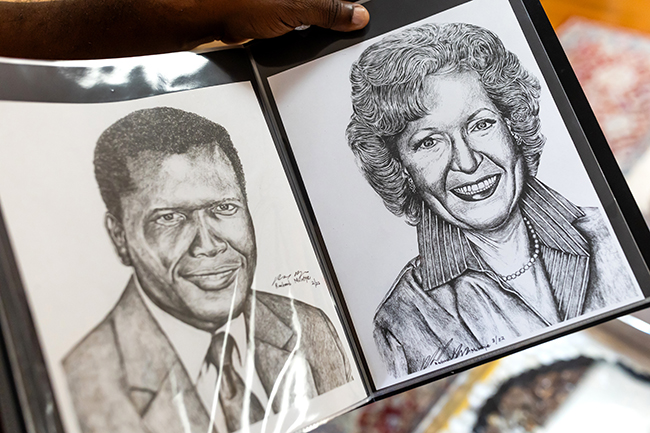
McIntyre’s meticulously honed ability to capture images with words extends well beyond architecture and historic landmarks. He is equally captivated by people and their stories, creating works inspired by figures including Barack Obama, Frederick Douglass, Maya Angelou, Princess Diana, Margaret Thatcher, John F. Kennedy, Neil Armstrong and Michael Jordan — as well as his mother. Popular culture also finds its way into his work. McIntyre has created pieces featuring Johnny Depp’s Edward Scissorhands and Lt. Uhura from “Star Trek.”
One of his most captivating pieces is a self-portrait enclosed in a Lucite box. From the front, the colorful, three-dimensional work appears almost abstract. Viewed from the side, however, its construction becomes clear. Originally created as a final project for a studio course at CFCC, the collage is built from an assortment of plastic bottle caps, buttons, pine cones and miniature military figures. It was later featured at the University of Texas at Dallas’ Callier Center for Communication Disorders as part of an effort focused on autism and art.
McIntyre’s creative work is not limited to word-based images. His multimedia pieces include a detailed Japanese wood spider rendered on a faux-fractured silk canvas, with Mount Fuji looming quietly in the background. He has also captured the beauty of azaleas in watercolor for a piece submitted to North Carolina’s Azalea Festival.
As reserved and reflective as McIntyre can appear in person, his artwork speaks openly about his interests, experiences and personality. Carrie says her son was diagnosed with Asperger’s syndrome during childhood and experienced learning and social challenges. His artistic ability, however, emerged early. She recalls a fourth-grade teacher telling her, “Your son has a real talent for drawing.”
Carrie continued to nurture that talent. She remembers that McIntyre “has always loved to read” and spent his allowance on art supplies as a child. Although social situations could sometimes be difficult, Carrie says his artwork helped him connect with others.
“Rachard was always admired by the other kids for his art,” she says. “While he’s never quite fit in, he certainly does belong.”
McIntyre found a particularly strong sense of belonging at CFCC, where he graduated after taking a range of art classes, including painting, photography, ceramics and metalwork. When asked about his artistic influences, McIntyre quickly names Andy Warhol. Like Warhol, who often found artistic possibilities in ordinary objects and images, McIntyre is drawn to creativity and detail.
McIntyre describes the process as “almost like magic.”
“I like amazing people with my art,” he says.
Before I left, I asked McIntyre how autism has shaped his life. “Autistic people may have trouble being social, but it also gives them talents,” he says. “Autism is mysterious.”
His advice to other aspiring artists is equally straightforward. “Never give up your dreams,” he says. “Keep God in your life because he will make everything possible. Don’t let autism stop you from doing art.”
McIntyre is a member of the Autism Society of North Carolina, and he and his mother have participated in fundraising efforts for the organization. He also regularly displays his work at the Riverfront Farmers Market and the Hannah Block Historic USO/Community Arts Center in downtown Wilmington.
Visit artbyrachard.com to learn more about his work.