Joe’s Garage
04 Jul 2026
Inside one man’s workshop of radios, clocks and the quiet art of bringing history back to life
July-August 2026
Written By: Larry Rubin | Images: Madeline Gray
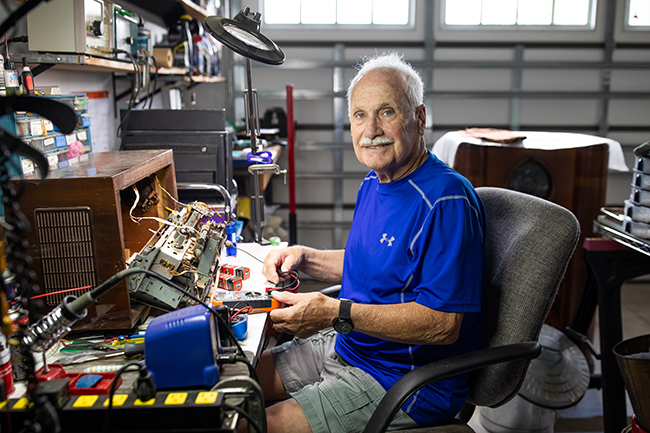
If a picture is worth a thousand words, then what’s the value of hearing Thomas Edison’s own voice speaking to us over a 1918 Amberola 30 cylinder-record player, or that first crackle of life in a long-quieted 1936 Philco AM/shortwave radio, or the distinct chime of a 1940’s Mark I maritime deck clock? It may be hard for us to say, but not for 78-year-old Joe Beckley Sr., who knows firsthand the thrill of bringing one of these ancient relics back to life in his Mallory Creek garage workshop.
My journey to discovering Joe was interesting in its own right, though relatively simple compared to his richly storied life. While scrolling through the Facebook Marketplace, I came across a mid-1920’s RCA 7-tube RCA Radiola. I had only once before seen one of these ancient beauties in a quiet corner of Wilmington’s ArtWorks. Soon enough, I was in Compass Pointe, purchasing this old classic from Paul, a retired collector who had inherited it from his grandmother fifty years earlier.
While it hadn’t run in years, it wasn’t hard to imagine Paul’s grandparents, and perhaps his parents, perched before it, listening to a local news report, the weather, or popular music of the day. After a little detective work, a friend at Leland’s Habitat for Humanity told me of one of their volunteers, a tinkerer named Joe, who fixes some of their older electronics. Not long after, there I was, in Joe’s garage.
With a youthful smile and exuberant handshake, Joe welcomed me in, quickly offering, “I don’t know how or where these people find me…I never advertise.” While Joe was laser-focused on repairing a ship’s clock when I crossed into this electronic wonderland, a glance around soon revealed multiple ongoing projects, from a seemingly simple 1950s Regency TR-1 transistor pocket-sized radio — the first such commercial offering — to an impressive early-1970s Zenith Trans-Oceanic Royal D7000Y behemoth. I knew an adventure was afoot.
As we chatted that day, I learned about the near-mystical workings of AM radio and the theory behind it, the history of ships’ clocks, and one septuagenarian’s seemingly insatiable need to learn, to explore, and not only to hold onto but to bring back to life these amazing machines. These were the mechanical, electric, and electronic marvels that were our ancestors’ literal lifelines to the world beyond their immediate reach.
Generations tuned in for news of their upcoming church bake sale, the Sunday afternoon ballgame, a president’s fireside chat, news of war and hopes for its end. Joe had lived through much of this, and as I tuned into his story, he forewarned me: “It hasn’t been a money life, but it sure has been an interesting one!”
Joe was born 78 years ago in Syracuse, New York, the same year, he cheekily reminds me, of the Roswell incident. Always a curious soul, Joe took woodshop in high school, which he says, “I liked alright, but not as a career.” After graduating, he worked for a few years in machine repair, then was drafted at 20, serving for two years in the infantry stationed at the DMZ in Korea. After leaving active duty, Joe spent the next 17 years in the public affairs branch of the Army reserves, where he was assigned to the garrison unit and coordinated press tours. After leaving the military at age 35, Joe married, had two children, and moved to Arizona, where he worked for many years in the entertainment business staging events, doing character acting, and generally “repairing things that broke down.”
At 63, Joe and his wife moved to Southport, where, because of his love of the water, he joined the Merchant Marine, eventually becoming a licensed chief engineer, whose job was to quite literally “keep the boat afloat.” Enthralled by the power, workmanship, and beauty of big machines, Joe settled into boiler repair, where he remained until fully retiring, albeit still fiddling and fixing.
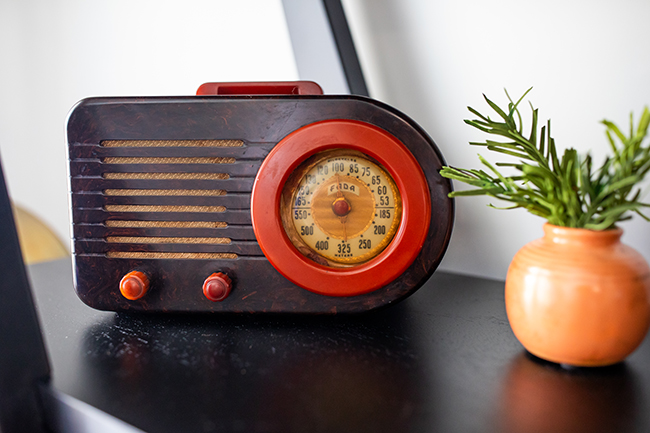
Before leaving Joe's garage, he introduced me to his wife, Nancy, a collector in her own right, and gave me a quick tour of what remains of his own collections. There were some great vintage plastic transistor radios, a beautiful 1900 tiger oak Gilbert kitchen clock that belonged to his mother, and a magnificent brass ship's engine telegraph. You remember those, don’t you? They’re the ones that frenzied movie boat engineers used to change speeds to avoid that next iceberg or mine. But this was a real one.
Truth be told, and as much as I hoped Joe could breathe life back into my Radiola — which he did — I was secretly and perhaps selfishly hoping that he could reveal the metaphoric connection between preserving and revitalizing old machines and maintaining the spark in life. Somewhere in our conversation that day, I got my answer. Joe simply said, “To get one of these things running again is like preserving history. Once it’s gone, it’s gone. Maybe someone, someday, will think of me when they’re listening to a radio I repaired.” I had my answer: simple on one hand, but deeply existential on the other.
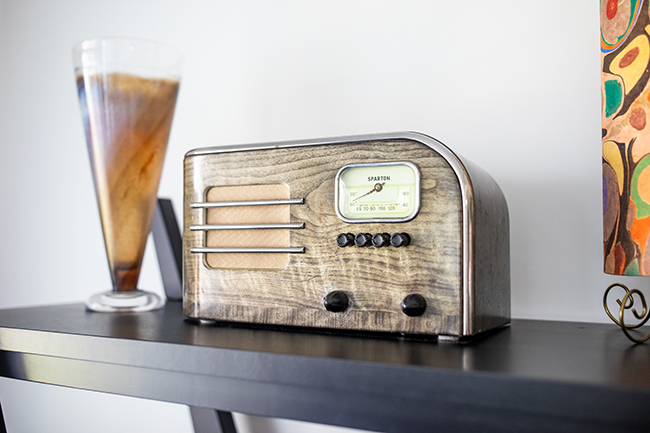
When I asked Joe what his own grail-quest piece was, he quickly answered, “A 1935-1938 Zenith 1000-Z Stratosphere…it is a 25-tube monster, their flagship radio...that would be great fun to explore and get running!” While I suggested that he’d have that baby up and running in no time, he humbly replied, “I’m one of those people who never mastered anything but dabbled in everything.” I begged to differ.
As I think back on my time with Joe, I wonder how many others like him there are out there — weekend crafters, lifetime tinkerers, bold adventurers, timid first-timers — craftspeople of all ages and skill levels, cloistered away in their private spaces, fixing, restoring, building, exploring and keeping the past alive.