Forged by Fire
04 Jul 2026
Blacksmith Autumn Day is keeping a centuries-old craft alive, helping thousands discover the satisfaction of making something by hand
Written By: Jen Reed | Images: Autumn Day
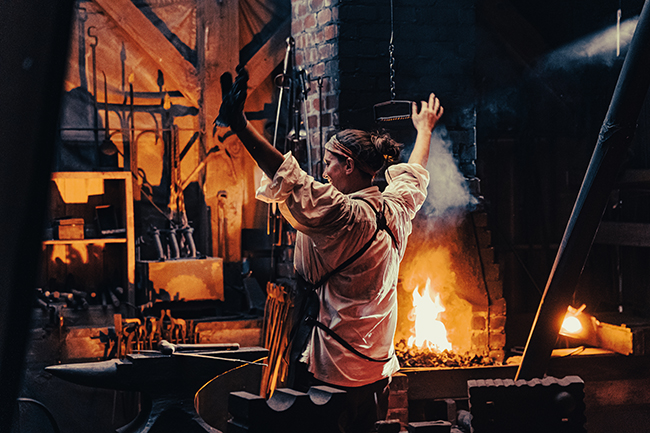
Inside the blacksmith shop at Poplar Grove Historic House and Museum, steel glows orange and yellow in the forge before Autumn Day brings down her hammer. Visitors gather near the doorway to watch the metal bend and take shape. Children edge closer. Adults linger with questions.
Some are surprised to discover that the blacksmith behind the anvil is a woman. It is, after all, an historically and presently male-dominated trade.
Day has grown accustomed to those reactions during her 10 years at Poplar Grove. What she did not anticipate was how many people she would eventually welcome into the craft herself. Through demonstrations, classes and open-studio opportunities, she has taught more than 8,000 students how to work with fire, steel and their own hands.
“It makes me happy to see students leave so excited,” she says.
Her path to the forge was far less direct. After graduating from college, Day spent 12 years working in retail, uncertain about what she wanted to do next. Blacksmithing remained in the background—more persistent fascination than career plan.
“I really didn't know what I wanted to do,” she says. She was, however, always “drawn to metal.” Growing up in the Charlotte area, Day spent summers around her father and grandfather, both auto and motorcycle mechanics. While other children might have avoided the noise and grime of the shop, she gravitated toward it.
“I was completely a tomboy,” she says. Tools did not intimidate her, nor did getting her hands dirty. Long before she entered a blacksmith shop, she was watching how things fit together, how they worked and how they could be repaired.
At UNC Charlotte, Day enrolled in a metalworking course that introduced students to welding and blacksmithing. Working with tools and metal already felt familiar, but the forge offered something new. She could heat a rigid piece of steel until it became malleable, then shape it with a hammer.
Though she couldn’t stop thinking about it, blacksmithing did not immediately become a profession. Day entered retail and continued learning the craft whenever she could, taking workshops and searching for opportunities to build her skills. Finding a mentor proved difficult, apprenticeships were scarce, and many of the leads she pursued throughout the Southeast went nowhere. She searched online, visited historic sites and looked for someone willing to teach her.
Then, in 2016, she learned that Poplar Grove was searching for a blacksmith and had been without one for more than a year. Day arrived without knowing exactly where the opportunity would lead. A decade later, the forge has become one of Poplar Grove’s most popular stops.
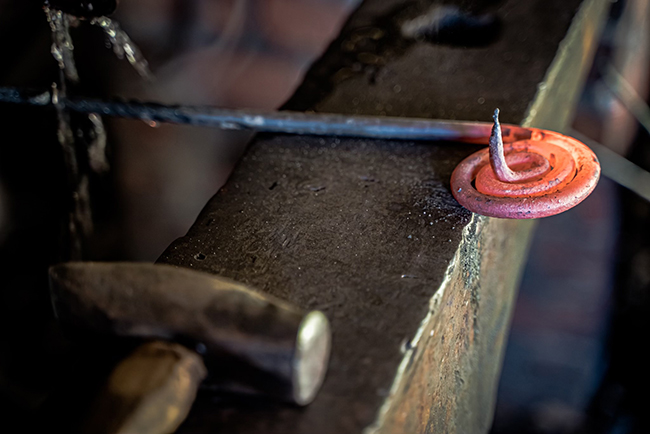
Part of its appeal is the transformation taking place in plain view. Day heats the steel until it glows, then uses a hammer and anvil to shape it into hooks, tools, decorative pieces and other objects. Where visitors might initially see a hard, unyielding material, Day sees possibility.
She describes metal as forgiving. If a piece does not turn out as planned, she can return it to the fire, reheat it and try again. “You can come in and smash stuff,” she says with a laugh. “If it doesn't come out right, you can just start over.”
That freedom is part of what makes blacksmithing approachable for beginners. Day’s demonstrations eventually grew into a larger educational program, which now includes three classes as well as studio opportunities for students seeking additional forge time and access to equipment.

Many students arrive convinced they will not be able to do the work. Then they heat the metal, pick up a hammer and create something of their own. Some leave with a new appreciation for the trade. Others return for additional classes, and a few become serious students of the craft.
For Day, their initial uncertainty makes their eventual pride even more rewarding. Some of her most meaningful interactions, however, happen outside formal classes, when children step into the shop and see her standing at the forge.
When Day first became interested in blacksmithing, women were still the exception in the traditionally male-dominated trade. She had never seen a female blacksmith herself. Now, she has become that example for someone else.
While Day continues to teach others, she remains a student of the craft herself. She is particularly interested in reproduction work, recreating the ornamental iron pieces found on historic houses and buildings. Decorative hinges, brackets and architectural details can be difficult to replace as the traditional skills needed to produce them become less common. Re-creating those pieces requires an understanding not only of metalwork, but of the history behind it. Through that work, Day hopes to help preserve another dimension of the craft for future generations.
For now, the forge at Poplar Grove rarely stays quiet for long. Students arrive ready to learn. Visitors stop in the doorway to watch the metal glow. Children ask how the tools work and what Day is making next.
Someone once introduced her to blacksmithing and showed her what could be created with heat, patience and a hammer. Ten years into her work at Poplar Grove, Day is passing that discovery along—one student and one piece of steel at a time.