A Legacy 90 Years in the Making
03 May 2026
A WWII icon saved by North Carolinians, the Battleship North Carolina is restored for the future while honoring the past
May-June 2026
Written By: JOE JANCSURAK
A WWII icon saved by North Carolinians, the Battleship North Carolina is restored for the future while honoring the past
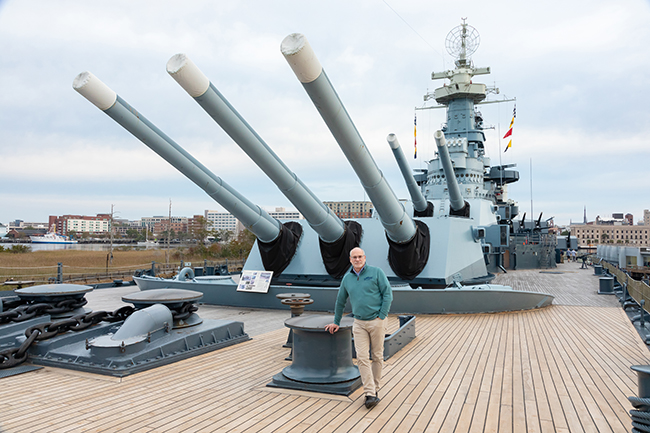
When the keel of the USS North Carolina (BB-55) was laid in 1937, before her 1940 launch and 1941 commissioning, the Navy projected a service life of 20 years—typical for battleships of that era. That this historic, entirely self-supporting attraction will soon turn 90 speaks volumes about the dedication of the staff and contractors who steward the extensive preservation work each year. Their efforts include the long-term restoration of the teak planks and steel decks—now being refurbished section by section over a 10-year span—to ensure the ship’s structural and historical integrity. Special lighting upgrades, such as the 2024 “Light the Legacy” project, now illuminate the superstructure for holidays and special events. A second phase will add lighting to the big guns, further enhancing the presence of the Battleship North Carolina on Wilmington’s skyline.
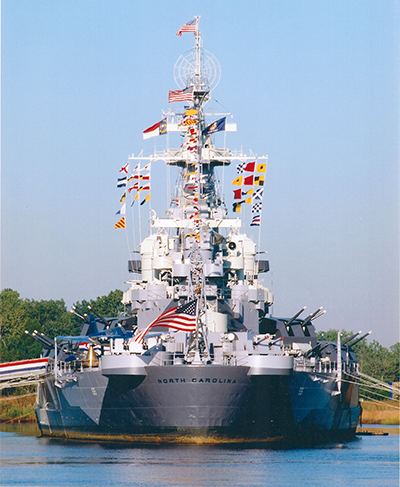
See, Celebrate, Honor, and Remember
After being decommissioned in June 1947, the ship was slated for a New Jersey scrap yard, just miles from the Brooklyn Navy Yard where the 728-foot-long, 108-foot-wide vessel was built—an end hardly befitting the first United States battleship designed for World War II, a 44,800 metric ton powerhouse capable of speeds of 28 knots with a crew of 2,300. In 1961, when the Battleship was at risk of being lost forever, children from all 100 counties stepped up. Through the statewide “Save Our Ship” campaign, they gathered whatever change they had—pennies, nickels, and dimes dropped into jars, lunch money set aside, and small gifts from families and neighbors. Together, an estimated 750,000 children raised about $300,00—nearly $3 million in today’s dollars—to rescue the ship, bring her home to Wilmington, and ensure her story would continue.
Today, the Battleship welcomes more than 230,000 visitors annually—nearly half from out of state—who come to experience the ship and honor her crew and the 11,000 North Carolinians who never returned from World War II. It is the legacy of the “Save Our Ship” campaign that made public access to the Battleship possible.
“We’re inviting ‘Save Our Ship’ donors to share their stories as we make sure their contributions are honored during our upcoming ‘Berth-day’ celebration—named for a ship’s mooring berth-- October 2-4 to mark the 65th anniversary of the Battleship North Carolina’s arrival in Wilmington,” says Dr. Jay Martin, who celebrated his second year as executive director in May. Speaking with Wilmington Magazine inside what once served as the ship’s captain’s cabin, Martin recalls knowing, during his first visit to Wilmington 25 years ago to attend an Historic Naval Ships Association meeting, that he wanted to be executive director of the Battleship North Carolina.
Note: If you or someone you know helped with the “Save Our Ship” campaign, please share your stories, photos, or videos at battleshipnc.com/dimes.
The same level of commitment shown in honoring the “Save Our Ship” extends to preserving the memory of the 11,000 North Carolinians who died in World War II and the 9,000 crew members who served aboard.
Visitors can explore nine levels of the Battleship, moving through spaces where sailors lived, ate received medical care, worshipped, and found small comforts in the ship’s store and soda fountain. Self-guided or guided tours reveal how this “City at Sea” operated day-to-day while also highlighting her role as the Navy’s most advanced battleship of the time.
Along the way, guests can see where ammunition was stored and moved, step onto the bridge where the captain commanded the ship, and visit the Combat Information Center (CIC), the technological nerve center during Pacific operations. Throughout the tour, visitors are invited to pause at the Rolls of Honor, which commemorate the North Carolinians who gave their lives in World War II, underscoring the Battleship’s enduring role as a living memorial.
But the commitment to understanding history extends beyond traditional visitation. As part of its mission, the Battleship North Carolina Memorial offers immersive educational programs for K-12 students, bringing history—and the people who shaped it—to life. “Our ‘Price of Freedom’ program shares the personal stories behind the war, helps students understand what courage, resilience, and sacrifice look like, and why those qualities still matter today,” says Martin, a maritime historian, educator, and museum administrator with 40 years
of experience.
A priority for the Battleship’s team is careful stewardship of the flood-prone Eagles Island environment the ship calls home. Through its multi-million-dollar “Living with Water” initiative, areas once used for parking have been re-naturalized into restored wetlands, complete with a tidal creek. Remaining parking has been elevated, and new trees and vegetation help to capture and direct rainwater into these revitalized habitats. “This project demonstrates adaptability and resilience and is already becoming an example for other institutions facing similar challenges,” says Martin.
Another example worth emulating is what the Battleship herself represents: the ability of Americans to unite behind a common purpose. “We came together as a nation to win World War II; then we came together in 1961 as a state to save the ship and achieve something special. I’m proud of our dedicated staff of 36 and our 200 volunteers who come together to work hard at preserving the ship’s legacy and its future.”