A Taste of History
04 Jul 2026
Through Saltwater Stories, Cedric Harrison and chef Keith Rhodes are preserving Wilmington’s Black coastal history — one course at a time
Written By: Jade Neptune | Images: Jade Neptune
A hush falls over Voyce Bistro as Cedric Harrison begins to speak. Diners lean forward as Harrison transports the room to another Wilmington, one shaped by Black entrepreneurs, coastal communities and gathering places that have largely disappeared from the landscape.
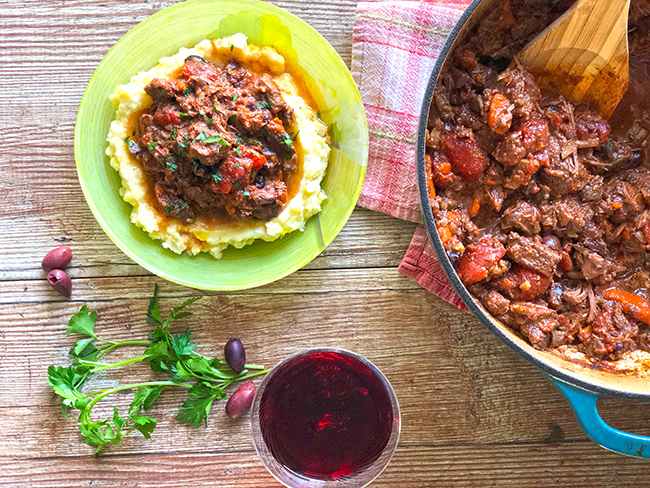
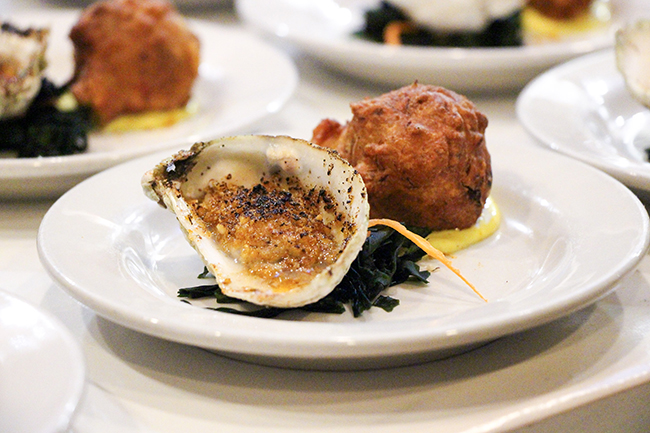
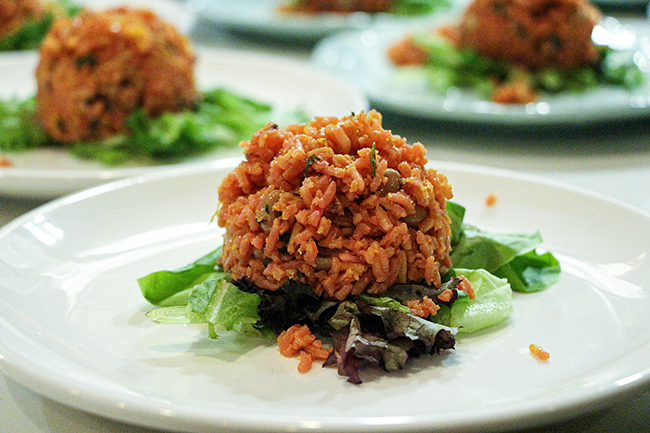
In front of each guest is a meal inspired by that history: Stump Sound oysters, deviled blue crab fritters, Carolina Gold rice and Sea Island peas. The dishes do more than accompany the story. They help tell it.
“One of our little catchphrases is ‘we’re not just a tour; we’re a time machine,’” Harrison says. “With the Saltwater Stories dinner and storytelling experience, it adds to our catchphrase of not being able to just go back in time, but being able to taste history, too.”
Launched in April 2026, Saltwater Stories is a collaboration between Harrison, founder of WilmingtoNColor, and chef Keith Rhodes, the two-time James Beard Award nominee behind Voyce Bistro. The dinner series combines historical storytelling with menus rooted in the foodways of the Cape Fear region’s Black coastal communities.
Its first subject was Shell Island, a once-thriving resort where Black residents and visitors could enjoy the water during the segregation era. Future dinners will explore other communities whose histories remain embedded in Wilmington’s identity but are often missing from its most familiar narratives.
“We’re telling the unknown story of Wilmington,” Harrison says.
Harrison founded WilmingtoNColor to illuminate the people and events frequently overlooked in conventional accounts of the city’s history. The nonprofit is perhaps best known for its 90-minute downtown tour, which examines the 1898 Wilmington massacre and coup, along with the lives and accomplishments of Black residents before and after the attack.
“We first got started by just telling the stories that it seemed like nobody was telling in Wilmington,” Harrison says. “That’s how we started to tell the story of what everybody knows us for — our 90-minute general tour downtown, where we talk about the 1898 government overthrow and massacre and the overlooked history before and after that event.”
As WilmingtoNColor’s programming grew, Harrison began thinking beyond downtown. Wilmington’s history, he knew, did not stop at the riverfront or the borders of the historic district.
“We realized no one was talking about the story of Sea Breeze or the story of Shell Island and Wrightsville Beach,” he says. “We just wanted to start telling the stories that are literally right here under our noses in Wilmington every day.”
The question was how to make those histories tangible. The answer arrived at the table.
Reclaiming Shell Island
The Shell Island Beach Resort was located on the north end of what is known today as Wrightsville Beach. In 1923, when the resort was founded, the area was an uninhabited island separated from the rest of Wrightsville Beach by Moore’s Inlet. The resort was open from 1923 to 1926 and was founded by Mayor Thomas H. Wright. It was jointly run by two groups: Home Realty Co. and the Black-owned Shell Island Beach Development Co.
During the segregation era, Black residents were excluded from many of the region’s beaches and recreational spaces. Shell Island offered a rare alternative: a coastal destination created for Black visitors and promoted beyond Wilmington.
A surviving postcard depicts Black beachgoers standing in the shallow water. Promotional language described the destination as a “National Negro Playground,” a phrase that reflects the language and racial realities of its era. The phrase was originally coined by the Wilmington Morning Star in the “Negro Industrial Supplement” of the newspaper in June 1924.
Only a few years after it opened, the resort was destroyed by fire on June 2, 1926. The cause is unknown, although many suspected arson. The blaze destroyed most of Shell Island, and the resort was not rebuilt.
Little visible evidence of the destination remains today, making storytelling especially important to Harrison and Rhodes. To tell these stories, they draw from a range of local sources, including family documents, oral histories, the New Hanover County Register of Deeds, newspaper articles and more.
“This story is unique to this area, so the experience is unique,” Harrison says. “It’s just not a story that can be mimicked in other communities.”
Rather than present Shell Island as an isolated historical curiosity, Saltwater Stories connects the resort to the food, labor, entrepreneurship and traditions of the people who built coastal life in southeastern North Carolina.
“Our story is just not to be forgotten — the foodways of the folks in our area who shaped lives,” Rhodes says. “Wilmington has a powerful Black food story, as folks will soon see through our upcoming stories. There are a lot of Black families that were the first and the only ones to do a lot of things here in this community, and that story needs to be told in a time where history is being erased and taken away from us.”
History on the Plate
At Voyce Bistro, Rhodes translates those stories into a multicourse meal. Guests file into the historic restaurant on Market Street for dishes inspired by Black history in coastal Carolina and prepared in ways that pay homage to food traditions of the 1920s.
The main course, featuring boiled fish, was created in the image of a Bahamian-style fish boil, a preparation less common today but a staple in many island cultures. The course honors the Gullah Geechee people, West Africans skilled in rice cultivation, whose influence spread across the Southeast, including North Carolina, South Carolina and parts of Florida.
Many of the side dishes, including Carolina Gold rice and Sea Island peas, are grown locally in coastal Carolina. To complete the evening, Rhodes’ daughter, Kristen Rhodes, serves her chess pie with seasonal strawberry ice cream, a dessert inspired by menus of the early 1900s.
The recipes are derived from local family traditions passed down through generations in coastal Carolina. The menu may include Stump Sound oysters, deviled blue crab fritters, Carolina Gold rice and Sea Island peas — ingredients that evoke the waterways, farms and kitchens of the Carolina coast.
But Saltwater Stories is not intended to be a conventional history lecture followed by dinner. The food and storytelling unfold together, allowing guests to consider how history can be carried not only through documents and landmarks, but also through flavor, technique and memory.
“It’s a real reality for people to realize how far we’ve come now with our daily cuisine,” Harrison says. “We have people who came to the first one, which sold out in the first week, who are coming to the next one. Especially when we’re telling the same story and serving the same meal, we definitely appreciate that. I think that speaks highly to the experience.”
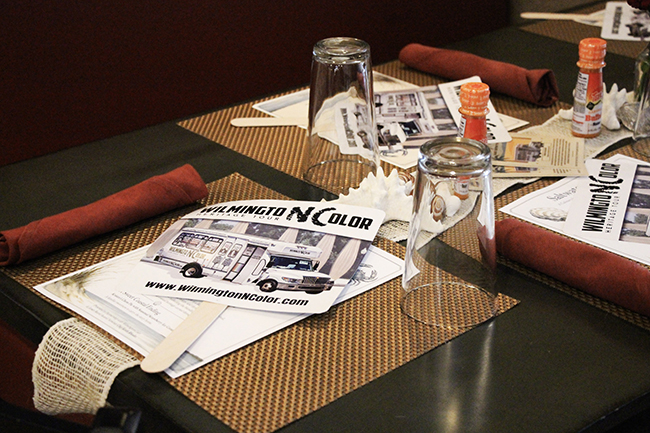
The setting adds another layer. Voyce Bistro occupies a historic building on Market Street, a short distance from the Cape Fear River. Guests arrive from across North Carolina and neighboring states. Some come with friends or partners; others sit beside people they have never met. At each place setting is a hand fan featuring WilmingtoNColor artwork.
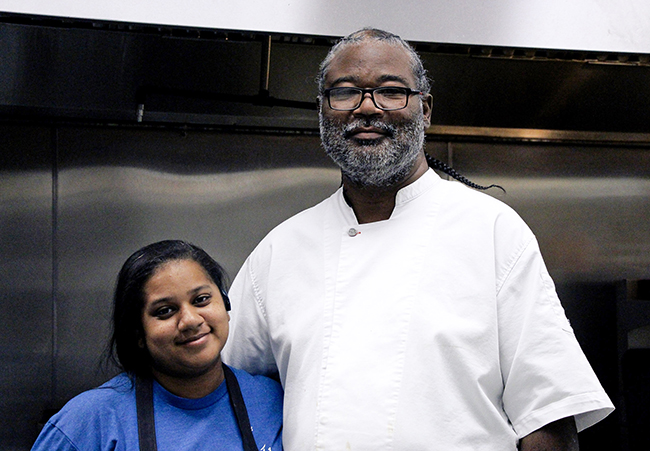
Harrison welcomes guests at the door while Rhodes and Kristen oversee the carefully plated courses in the kitchen. As each course arrives, the room moves between conversation and attentive silence. Diners recognize familiar street names, seafood traditions and community references. Some nod as Harrison and Rhodes describe places their families once visited. Others encounter the history for the first time.
Beyond Shell Island
Saltwater Stories will eventually expand beyond Shell Island to explore Sea Breeze and other communities connected to Wilmington’s Black coastal history. Located near Carolina Beach, Sea Breeze became a destination where Black residents and travelers could eat, dance, swim and gather during segregation. Its businesses and nightlife made it an important center of Black coastal culture.
“Namely, one coming up is about the Sea Breeze community as you head out to Carolina Beach,” Rhodes says. “That’s going to be a really in-depth talk about that community, its foodways in that particular area, and we’ll also be talking about gentrification in that area as well — land loss and keeping generational wealth.”
For Harrison and Rhodes, remembering these places is not only about correcting the historical record, but also about recognizing how deeply their influence remains woven into present-day Wilmington.
“We feel like the stories and the people who have been roaming these streets and sidewalks for over a century are some of the same people whose shoulders we get to stand on,” Harrison says. “They created the energy and the foundation for what Black entrepreneurs or minorities can do in Wilmington at any level.”
An Appetite for More
The first Saltwater Stories dinners sold out, filling every seat at Voyce Bistro. Harrison and Rhodes hope the interest will continue as the series introduces audiences to more people, places and traditions.
By the end of the evening, little remains on the plates beyond an oyster shell or a stray grain of Carolina Gold rice. But the stories linger. Through food, Harrison and Rhodes invite residents to see the city differently — not only as a destination defined by beaches and tourism, but as a place built by generations of people whose influence can still be felt along its streets, waterways and tables.
“If you want to live in Wilmington, you should know about this,” Rhodes says. “Whether you feel it or not, the story should be something that everyone is acquainted with. Wilmington is more than just beaches.”
Visit wilmingtoncolor.com for upcoming tours and Saltwater Stories dining experiences.