The Soul of the Forest
03 May 2026
Live oaks shape the coast with beauty, history and vital habitat
May-June 2026
Written By: Eric G. Bolen and James F. Parnell
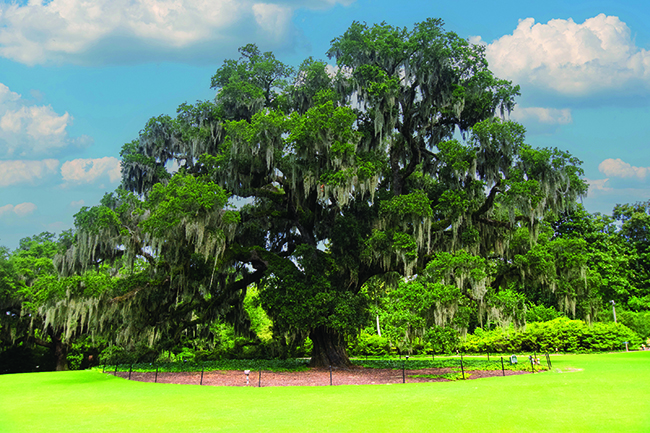
Oaks are the most frequently mentioned tree in William Shakespeare’s works. His repeated references suggest that oaks carried rich symbolic meaning in his writing and that he had a deep familiarity with their cultural and botanical significance. That enduring admiration feels especially fitting when one stands beneath a live oak.
A tree of the South, live oaks flourish on America’s coastal plain from Virginia southward to Florida and on to Texas. And while it’s the state tree of Georgia, these magnificent works of nature are no less prominent in North Carolina.
As forestry students decades ago, we learned to identify dozens of trees in dendrology classes, examining cones, leaves, nuts, bark and other features in lab and field alike. We survived the rigorous tests that followed, although live oaks hardly required much study — they are simply too commanding to forget. The leading dendrology textbook we used, now in its ninth edition, still describes live oak as the “most important” of its kind in eastern North America. The trees are extremely hard to kill, and when cut, numerous sprouts arise from the stump; if those sprouts are cut, even more appear. But the book’s authors caution that live oaks may not be as old as their massive girth suggests; counts of annual rings often chop centuries off these estimates. Still, a live oak we see today may be the sprout of a tree cut more than two centuries ago.
Mighty Giants
With age, live oaks commonly reach heights of 80 feet, but it’s the spread of their limbs that captures attention. These may extend outward for 60 or more feet on each side, with the lower branches often bending toward the ground before turning upward. This distinctive shape made live oaks commercially important in the colonial days of our nation: When hewed, the curved branches were perfect as ribs for sailing ships.
Their dense, strong wood could withstand stormy seas and even bombardment. Indeed, the frigate USS Constitution earned the sobriquet “Old Ironsides” when cannonballs literally bounced off the ship’s hull. The U.S. Navy once maintained a 1,300-acre forest of live oaks to supply heavy-duty timber; that site is now part of a national seashore.
The Pride of Wilmington
North Carolina’s state champ at Airlie Gardens dates to 1545 and sports a canopy spread of 104 feet and a trunk circumference exceeding 21 feet. In “Keeping Up With the Joneses,” author William Campbell Hunter described how this very tree, growing on property once owned by millionaire Pembroke Jones, became a focal point in his Gilded Age social life. With his wife, Jones hosted plush dinners on a platform secured to the tree’s stout branches. Guests ascended a spiral stairway around the huge trunk to reach a table set with showy cloth and sterling service.
The Airlie Oak has provided the backdrop for hundreds of weddings and inspired artists, most notably Minnie Evants, says Aryn Turner, guest services coordinator at Airlie Gardens, and is “the first thing people ask about after hurricanes.” To assure the Airlie Oak’s legacy, a tree farm propagates acorns from the fabled tree. Sales of the young trees, known as Heritage Live Oaks, fund the garden’s preservation and educational missions, both focused on the Airlie Oak.
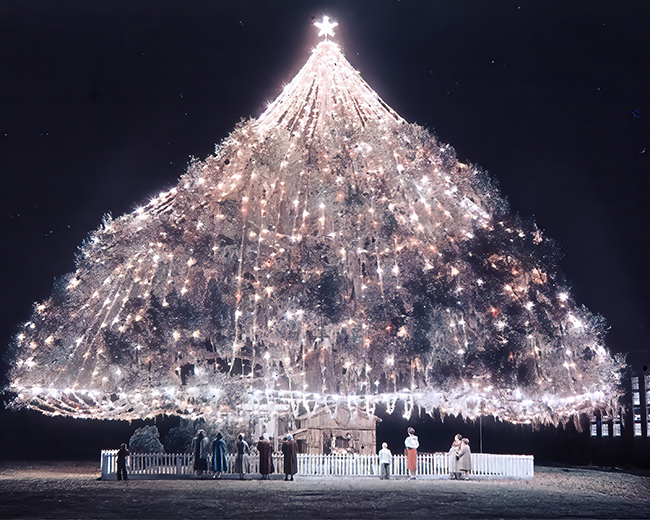
Another large live oak in Wilmington was recognized for decades as the world’s largest living Christmas tree. In 1927, City Commissioner James Wade offered a silver dollar to the schoolchild who found the largest live oak in Wilmington. A tree in Hilton Park topped the contest, though history has lost the name of the young winner.
First lit in 1928, the event prompted the Morning Star to declare, “Living Tree of Cheer Lightens Hearts of Many.” Cranes hoisted about 7,000 lights atop the 75-foot tree, and church choirs added Christmas carols to the festivities. As historian Chris Fonvielle reported in “More Curious Tales From Old Wilmington and the Cape Fear,” 130,000 people from 41 states and 14 foreign nations visited the tree in 1949. He summed up its history as “pure Christmas magic.” Old age, disease and storm damage ended the event in 2009 and required the tree’s removal in 2015, though a piece of its wood is preserved at the Cape Fear Museum.
Hangers On
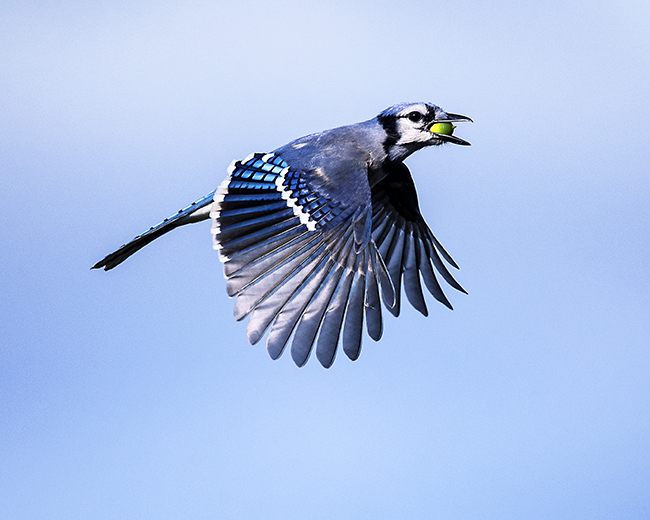
Live oaks are named for their leathery, evergreen leaves and small, sweet acorns, which feed animals including gray squirrels, black bears, blue jays and wild turkeys. Blue jays, as Henry David Thoreau observed, also help spread oaks by failing to recover all the acorns they cache.
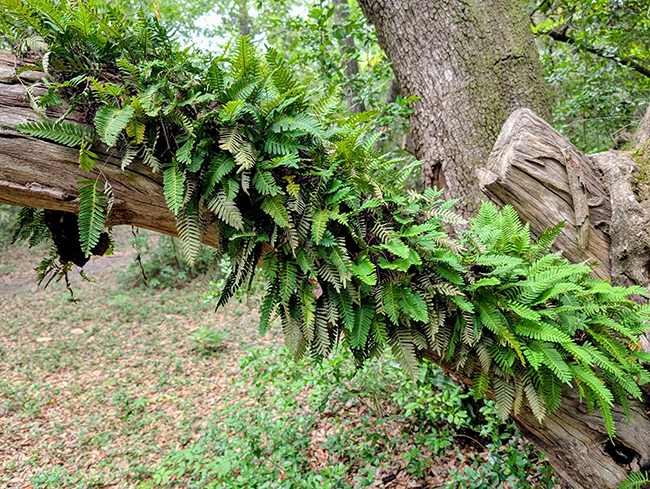
Gauzy drapes of Spanish Moss commonly dangle from the limbs of Live Oaks, adding to the charisma of the trees (although some think it’s mystic or spooky). Despite its tangled form and arboreal habitat, Spanish Moss shares a familial relationship with pineapples. It’s a harmless epiphyte, as are Resurrection Ferns, which spring into green foliage following a rain, only to return in dry periods to a withered clump of seemingly lifeless leaves.
Coastal Locations
Live oaks thrive even in sandy, salty coastal conditions, giving them an edge in maritime forests, the endangered barrier-island habitats they help define. As coastal ecologist Paul Hosier told us, their slowly decaying leaves, branches and roots release nutrients gradually, helping nourish understory plants. Restoration ecologist Amy Long of UNCW notes that these forests also help protect the coast from storm winds and floodwaters.
The sloping canopy of maritime forests, once attributed to sea winds alone, was shown by ecologist Bertram W. Wells to result from salt spray carried ashore on those breezes. As the canopy closes, it shelters more vulnerable plants beneath it, but storm damage and coastal development can break that protection.
Friends
We have long admired live oaks not just for their beauty, but for the life they sustain. Oaks host more insect species than other trees in our area, including hundreds of caterpillars that feed birds, nestlings and migrating songbirds.
Along with other woody plants, live oaks also form dense coastal thickets where birds find food and shelter. Painted buntings, mockingbirds and northern cardinals nest there, while migrants gather at Fort Fisher before crossing the mouth of the Cape Fear River — a concentration that also draws Cooper’s hawks and other raptors.
Membership
Uniquely, live oaks are the sole members of a society founded in 1934. The Live Oak Society includes no humans among its ranks, though a human serves as honorary chairman and enrolls new members. The society is dedicated to the preservation and conservation of live oaks, and its president is always the tree with the largest girth.
Current membership exceeds 10,400 live oaks in 15 states. Of these, Wilmington is home to 12 members, including the city’s much-photographed Airlie Oak. With a bit of imagination, we think Shakespeare might have found just the words for such a live oak — though perhaps none better than: What a tree!
Eric G. Bolen and James F. Parnell, professors emeriti in the Department of Biology and Marine Biology at UNC Wilmington, coauthored “An Abundance of Curiosities: The Natural History of North Carolina’s Coastal Plain.”