A Gallery of Their Own
03 Jan 2026
Masterpieces from Chagall to Matisse fill the Murray home
By Catherine Kimrey Breeden » Photos by Daria Amato
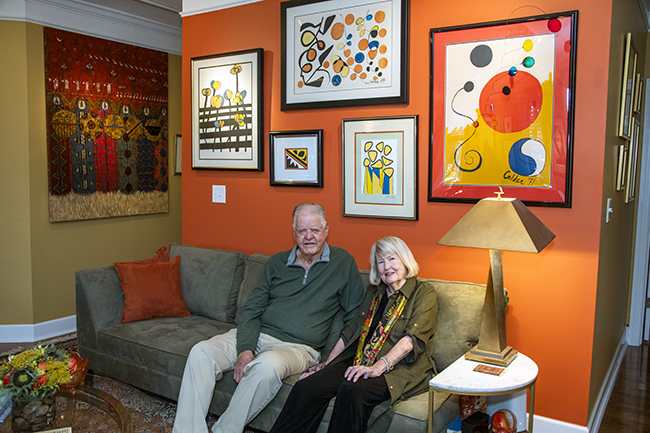
Stepping inside the home of Colette and Dick Murray is like entering a high-end art gallery. The difference is that nothing here is for sale.
A Marc Chagall triptych, consisting of three large, colored, signed and numbered lithographs from his “The Story of Exodus” portfolio, greets visitors in the foyer. It includes his famous “Moses and the Burning Bush,” and is the first of many museum-quality pieces in the Murray collection.
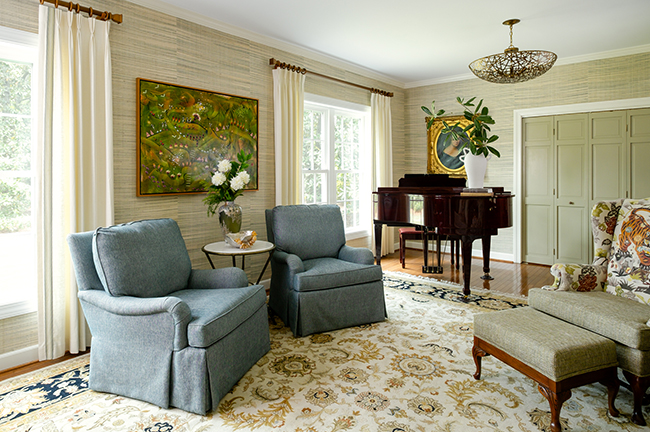
Rounding the corner into the living room, one’s attention is immediately drawn to the so-called “Calder Wall” that displays five Alexander Calder signed and numbered lithographs, and a Calder Studio mobile. “I find that a collection of related pieces displayed together allows the eye to travel comfortably,” Colette says. “The pieces don’t have to be by the same artist; they can relate by color, genre or similar themes. And it is important to choose a wall background color to enhance the beauty of the art.” Colette notes that as a young child, she knew Alexander Calder when their families lived near each other in Berkeley. She also knew Ansel Adams and has a personal postcard from him along with three of his photolithographs, which are prominently displayed in the breakfast room.
The breakfast room also features a second of the Murrays’ gallery walls, the “Picasso-Pfund” wall. Here one finds two signed and numbered Picasso lithographs; a lithograph they purchased from Picasso’s granddaughter Marina Picasso’s collection, which she signed; a Picasso print; a signed and numbered Picasso restrike etching; and a limited edition poster of Picasso’s “Self-Portrait” from his 1980 retrospective at the Museum of Modern Art. Alongside these treasures is a watercolor by Wilmington artist Chris Pfund—illustrative of the Murrays’ commitment to supporting women artists and local artists. Colette explains that the Pfund watercolor “Grounded” plays well with the Picassos because its abstract nature is reflective of his work.
A second Pfund watercolor, “Pears,” graces the breakfast room wall, and a Frederick Remington bronze sculpture, “Rattlesnake,” signed in the bronze, sits in the room. Dick Murray is especially fond of Remington sculptures; the Murrays have six in their collection. “The bucking horse in the ‘Rattlesnake’ is considered the most graceful of all Remington’s bronze sculptures,” Colette says. Another of Dick’s favorite artists is Dorothy (Dottie) Stanley, a highly regarded artist in San Diego who also shows in New York. She is a friend of the Murrays, and her oil painting “Wonderment” has pride of place above the living room fireplace. Two other of her oils, “Maasai Warrior” and “Market Place – Woman at Work,” are prominently displayed.
A very special piece dear to Colette’s heart is an original etching, “Two Young Girls” (circa 1918), signed by Pierre-Auguste Renoir. She inherited this etching at age 17 from her paternal grandmother, also named Colette. It is from Renoir’s late period, when he was crippled with rheumatoid arthritis but still maintained precision in his art. Hanging directly below the Renoir is a Rembrandt: “Self Portrait Drawing at Window” (1648), an etching with dry point and burin on laid paper, signed and dated in the plate.
The Murrays recently commissioned a “Half & Half” portrait of their daughter, Thea Kano, by Wilmington’s own well-known photographer and artist Billy Cone. Cone is noted for such distinct portraits, which are a combination of black-and-white photography and drawing. The Murrays gifted the original of this work to Thea, who is artistic director of the Gay Men’s Chorus of Washington, D.C. Hanging in their office is a signed and numbered giclee print, Artist Proof No. 1, of this special portrait.
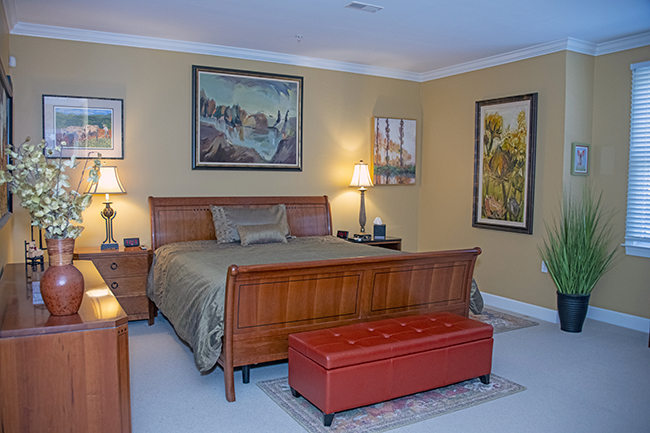
The Murray collection is vast and overflows into every room and hallway of their home. Around any corner, one might come face to face with an original Salvador Dali, Joan Miro, Henri de Toulouse-Lautrec, Frida Kahlo, Paul Cezanne or Francisco Goya, among many others. One of Colette’s favorites is Henri Matisse’s “Portrait” (1937) from the rare limited edition original lithograph on paper, signed in the plate. “I’m drawn to it,” she says. “I can hardly pass by without touching it.” It hangs in the primary bedroom. This room also features three watercolors by well-known artist Jinx Morgan, Colette’s sister-in-law. Morgan’s paintings reflect the fresh colors and brilliant light of her home in the Caribbean.
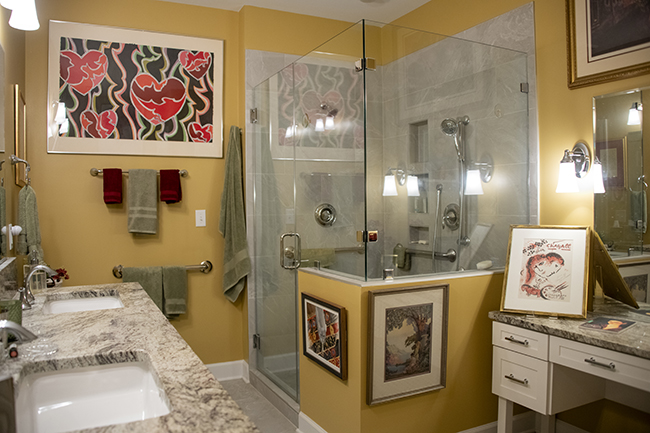
Anomalies in the Murray collection are two metal sculptural side tables, “Armless Woman” and “Armless Man,” fashioned from pieces related to the Constantin Brancusi Paris Studio. Despite their distinguished provenance—Brancusi was a leading avant-garde artist known for his distinctive carving in a variety of materials—a visitor to the Murrays’ home is as welcome to set a beverage or canapé on one of these tables as on any other. This is in line with Colette’s and Dick’s philosophy that art is to be enjoyed, not stored away out of sight. Anyone doubting this need only peek into their bathrooms and closets, or even the laundry room, for confirmation.
Colette and Dick Murray are as fascinating as their art collection. Colette has a law degree from the University of San Francisco but gave up her law career early on and became a master fundraiser for medical and university systems. Dick, a former Olympic swimmer and coach, is a graduate of Duke University. He was a pioneer in computing and writing code when they lived in Santa Cruz. Together, they started Paschal Murray, a specialized executive search firm for professional fundraising positions, which they have since sold.
Heather Wilson, chief executive officer of Wilmington’s Cameron Art Museum, says, “Colette and Dick Murray’s stunning collection speaks not only to their interest in art and artists. It reflects their shared life experiences, their personalities and their perspectives on the world. Colette has a refined eye and has led a fascinating life; her collection reflects that. Visiting their home allows you to understand how art can be integrated into our daily lives. One of my favorite experiences when visiting their home was when Colette let me sit in the place where she drinks her coffee in the morning with a perfect view of two Miros and a Dali.”