A Sea of Poinsettias
02 Nov 2026
Fifty years of tradition and months of careful growing fill the greenhouses at The Plant Place with holiday color
Nov/Dec 2026
Written By: Gabriella de Souza | Images: Gabriella de Souza
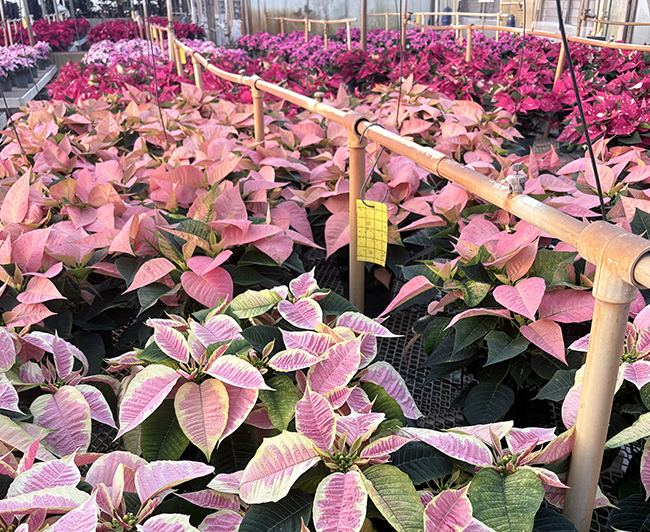
Every November, the greenhouses at The Plant Place turn red, pink, orange, and speckled white almost overnight. It looks like magic. It's actually nutrient management, daylight, and months of planning that started back in August.
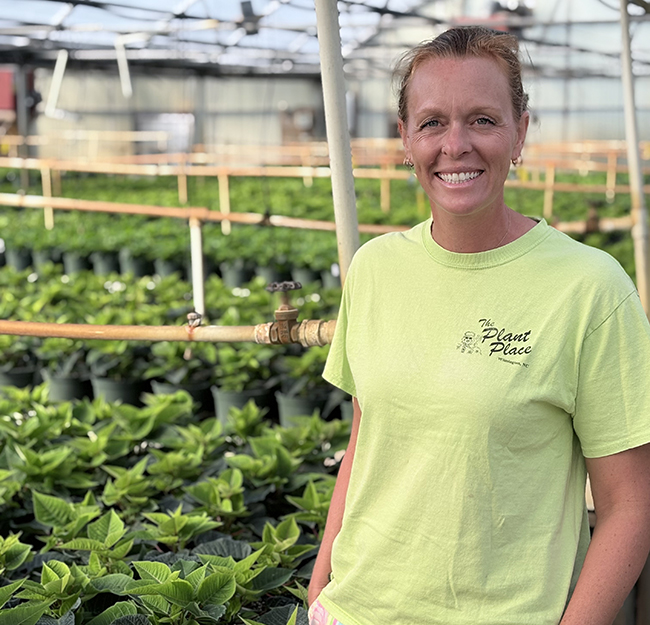
Kelly Currin, the grower who has run the poinsettia program at The Plant Place for the last four years, walked me through how it happens. This year marks the nursery's 50th anniversary. Bill and Bobbie Edwards started The Plant Place five decades ago, and Bill worked as head grower and horticulturist there until he passed away in 2024. Poinsettias were his pride and joy. Bobbie still runs the business today, and keeping his standards and his eye for the crop alive is something the whole team takes seriously.
"We start in August," Kelly said. "The first week of August is when the cuttings will come in." The rooted cuttings arrive from another grower who handles the plugs, and The Plant Place plants them in two rounds, one in each of the first two weeks of the month. For weeks afterward, the plants stay green. Nothing about them looks festive yet.
That changes as the days get shorter. What most people call the poinsettia's flower is actually its leaves, called bracts, changing color in response to shortening daylight. The real flowers are the small yellow structures at the center of each bract cluster, easy to miss if you're not looking for them.
Not every plant follows the same schedule. One variety changes faster than the rest, so Kelly's team moves it into its own greenhouse and puts it under artificial light for an extra hour or two a day, for about a month, to slow it down. Everything else grows under natural daylight, with no supplemental lighting at all.
If the light side of poinsettia growing sounds fairly hands-off, the nutrient side is not. "These guys are so fickle," Kelly said, "so keeping their nutrients at a good, even pace, and to make sure that they're absorbing their nutrients properly" is the hardest part of the job. A stretch of cloudy weather is enough to cause problems, since the plants can't pull nutrients through their roots as efficiently without sunlight. When that happens, the team switches to a foliar spray, feeding the plants directly through their leaves until conditions improve.
The Plant Place is one of many well-performing growers in the state, despite the recent national shift. In 2025, North Carolina dropped from second to third in the nation for potted poinsettia sales, according to the USDA's National Agricultural Statistics Service. Texas moved ahead by just $13,000, a margin of less than 0.1%, and California remained far in front. From 2023 until 2025, North Carolina's sales held steady at about $16.7 million, while Texas grew from about $9.5 million to $16.8 million over the same period.
The Plant Place grows about 10,000 poinsettias a year across 30 varieties, though Kelly says the full range of poinsettia colors and patterns available to growers is much larger than that. Roughly half of what they grow goes to local churches, who place preorders each year and can request delivery. Red remains the top seller by a wide margin, but Kelly has noticed more customers gravitating toward less traditional colors. “Autumn Leaves,” a burnt-orange variety, sells out every year, and speckled and pink varieties have picked up a following too. Kelly's personal favorite is “Ice Punch,” a red-and-pink marbled variety with leaf edges that resemble holly leaves.
Ask Kelly what the best part of the job is, and the answer comes in two parts. One is watching the greenhouses shift from green to full color, which she called one of her favorite things about the season. The other is watching the finished plants go out the door. "We put so much hard work into these things," she said, "and watching them sell and go out the door, and people loving them, that's another huge thing."
That care carries a little extra weight this year. With Bill gone, the poinsettia program has become one more way the crew honors what he built. Keeping his quality and his vision going, as Kelly put it, isn't a slogan for them. It's the standard they're growing toward every August when the new cuttings come in.
For anyone planning to buy a poinsettia this year, Kelly's advice is to not wait too long. Most of the crop starts changing color by mid-November, and the closer you get to the holidays, the more likely your preferred color will already be sold out.
Once the season ends, it’s still possible to keep a poinsettia alive. Treat it like any other houseplant: Keep it watered, don't let it become rootbound, and it should hold up fine through the winter. Getting it to change color again next year takes more effort. Because household lights stay on well past sunset, the plant never gets the uninterrupted darkness it needs to trigger new color. Kelly suggests moving it into a closet or dark room each evening starting in late October, then bringing it back out in the morning, and repeating that cycle daily until the color change begins.
It's a level of attention most people won't replicate at home, which is part of why Kelly and her team spend all fall doing it for us. By the time the poinsettias hit the greenhouse floor in full color, the plant has already been through months of careful, unglamorous work behind the scenes.
Gabriella de Souza, M.S., is a plant ecologist and Wilmington native dedicated to making plant science accessible for home gardeners across coastal Carolina.