A World in Miniature
03 May 2026
An intricate model town built by late artist finds new life inside local antique mal
May-June 2026
Written By: Judy Royal | Images: Madeline Gray
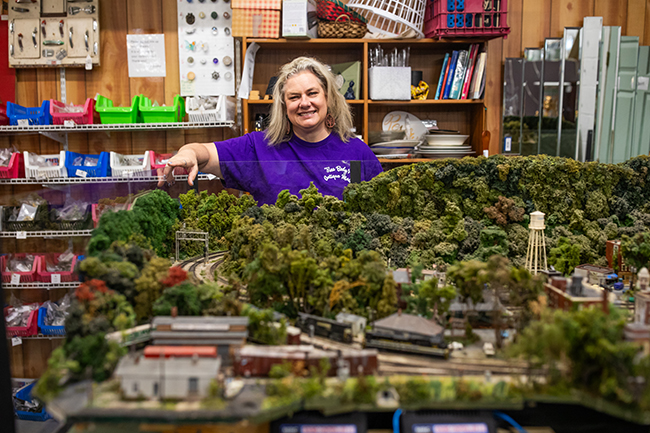
Tucked among the usual treasures at FleaBody’s Antique Mall — antiques, collectibles and other pieces of the past waiting for a second life — is a sprawling miniature town, alive with detail and intention. A train curves around the outer limits. Buildings dot the landscape. The longer you look, the more there is to discover.
For Jody Dorsey, the display at 3405 Market St. is more than a conversation piece. It’s a window into the creative mind of her late uncle, a longtime WECT art director whose imagination found its fullest expression not on television, but in a world of his own making.
Ronald Hawes — or “Uncle Ronnie,” as Dorsey refers to him — passed away last August, but much of his work lives on at Dorsey’s business. In addition to many of his original paintings on display, there is Glenville, created in 1996 and named after Hawes’ younger brother. It’s a fictional place that harkens back to simpler times, something that may have reminded Hawes of his early years. Anything that has a name in the town is inspired by a family member or friend.
“He created a world for himself,” Dorsey says. “Everything tells a story to him or us. He saw the world in a different way than most of us do. He never saw the bad in people whatsoever.”
Hawes, born in 1946, came to Wilmington with his family as a preteen and lived here for the rest of his life. He was passionate about art, trains and astronomy, becoming one of the founding members of the Cape Fear Astronomical Society. Hawes worked at WECT for 40 years, retiring in the early 2000s. Some of the artwork he created, such as the Sounds of Summer logo, is still used today, Dorsey says.
“He was one of the funniest, quirkiest people you would ever meet,” she says. “I’ve never met anyone who had one bad thing to say about my uncle. He was much loved in the community.”
Dorsey can’t say enough about how much she learned from her Uncle Ronnie, who was her father’s brother. He took her to air shows, train shows, movies and astronomy viewings.
“He was always teaching me things, and we had fun, too,” Dorsey says. “He was the best uncle a girl could ask for. He was just always creating and always painting and always pushing me to learn new things. The constant education I got from him was so valuable.”
When Hawes passed away last year, Dorsey found some of his early elementary school artwork and his first art portfolio from high school. He later attended James Sprunt Community College in Kenansville and received a degree in commercial art design. She recalls his painting desk splattered with various colors and brushes everywhere. His favorite medium was acrylics, but he also dabbled in pastels, chalk and watercolor, Dorsey says.
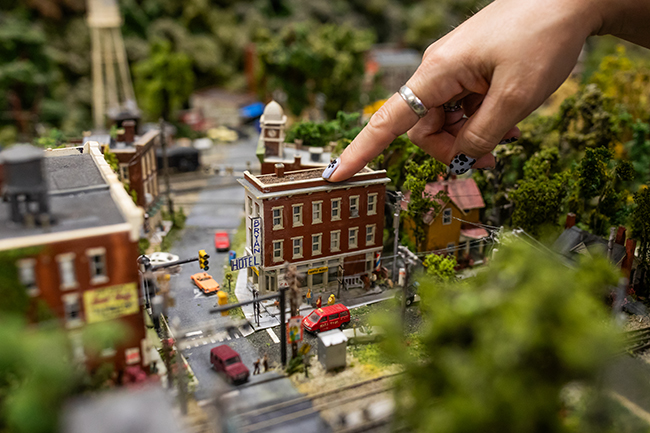
“It was very common in my life to be surrounded by his artwork,” she says. “I wanted so much to be able to draw like him. He painted from his mind’s eye, which was really incredible. He painted whatever inspired him and did not pigeonhole himself.”
Among Hawes’ most interesting works was a “flip book,” as Dorsey describes it, depicting the 1969 Apollo 11 moon landing. Hawes finished it in 1971. It features panels of artwork connected in a hinge-type fashion and folding out like an accordion or board game to its full size of 26 feet.
Glenville is the third and largest miniature town created by Hawes, who became enamored with trains as a child, when his grandfather was a train conductor. The first two towns no longer exist, but Glenville became Hawes’ labor of love, Dorsey says.
“He would work on it every day,” she says. “During the last year of his life, he was still trying to work on it. He took a lot of pride in it, and I think that train set is what kept him going. It gave him a goal.”
Not only did Hawes come up with evolving stories about what was happening in Glenville, but he was also meticulous about the level of detail in the town, Dorsey says.
“If he couldn’t hand-paint a sign or logo, he would pore through magazines and cut out a logo, paste it and age it so it looked like it had been there for years,” she says. “Every time I look at Glenville, I see something different, and I’ve been looking at it for 30 years.”
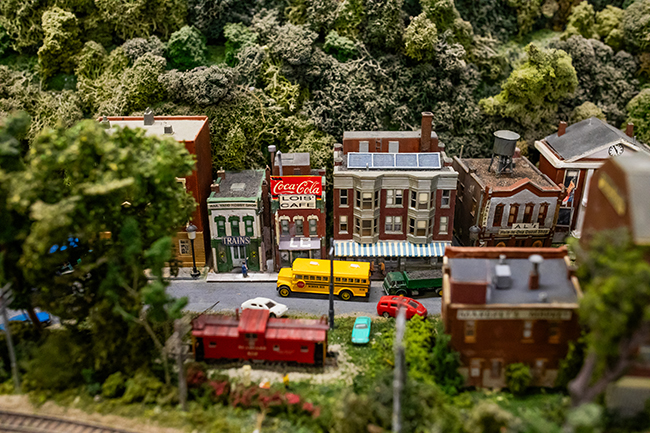
Dorsey promised Hawes before he died that she would take care of Glenville. She decided FleaBody’s would be the perfect place for it, not only because of the foot traffic the business brings, but also so she could witness people’s reactions.
“It’s a piece of Uncle Ronnie that we can see every day,” she says. “You could never pay me enough money to get to experience the joy that I get from telling people about it. There’s lots of fascination with it.”
Dorsey hopes those who see the display will appreciate the three decades of hard work that Hawes put into Glenville.
“If he knew this was in my shop and we get the interest in it that we do, he would be absolutely thrilled,” she says. “He was very humble and never saw anything special about himself. I don’t think he fully understood how good his artwork was.”