The Art of Costume
01 Sep 2026
For UNCW professor Mark Sorensen, costume design is where fashion, storytelling and theater come together
Sept-Oct 2026
Written By: Katie Schmidt | Images: Daria Amato
For some, Halloween is the one night of the year to think of wardrobe as a costume — to think of the ensemble you put together as a representation of a chosen character. And whether you’re trick-or-treating or hitting the party scene, for that night you’re someone else entirely.
For Mark Sorensen, professor of costume design at the University of North Carolina Wilmington’s theater program, Halloween is one of the few nights of the year he’s not thinking too much about costumes.
“The irony is I’m the worst person when it comes to dressing for Halloween,” he says. “People assume it’s my favorite holiday, but … I deal with costumes every day of my life. For me, it’s just another day.”
Growing up in the Sorensen household, with a mother who sewed clothes for Mark and his sisters, Mark always had an interest in fashion and clothing. When he was a kid, he had a pair of white overalls with green topstitching that he insisted needed to be paired with a green shirt to match the topstitching. “What kid thinks about things like that?” he says. Pair that love with an undercurrent of musicals playing in the background — think cast albums of “South Pacific” and “Oliver!” — and a path to costume design becomes clear, if not direct. While Mark performed in shows throughout junior high and high school, he realized before starting college at the University of North Texas that acting wasn’t his preferred route and opted to be an art major with an emphasis in fashion and a theater minor with an emphasis in costume design.
After graduation, Mark headed to New York City. “I had a free place to stay for a month, a way up there, and $700 in my pocket,” he says. “Which I always say is when you should do it; you should go when you’re young and silly and willing to walk everywhere and survive on coffee and bagels. It was fantastic.” Shortly after arriving in the city, Mark got a gig at a professional costume shop building costumes for “Sunset Boulevard” on Broadway, a handful of Disney on Ice shows and even Ringling Bros. and Barnum & Bailey Circus. A couple of years later, Mark transitioned to the fashion industry, working on children’s wear, tailoring Dolce & Gabbana outfits when they didn’t quite fit the famous person they were intended for, and working behind the scenes on photo shoots.
“It was fun, and I enjoyed it, but it wasn’t that creative,” Mark says. “So, I went and started doing regional theater and designing there, which was great and creative, but it was exhausting constantly looking for your next job, your next design.” Mark felt ready to move on and out of the Big Apple. “I was the stereotypical starving artist for six or seven years. It was great and it made me who I was and who I am right now.”
He got a job at Kansas State University (traded one Manhattan for a very different one) as a draper or pattern maker. (If you’re like me and need one more definition: the person who takes a sketch of a costume and makes it into something tangible and wearable.) For three and a half years, Mark worked as the costume shop supervisor at KSU before deciding to pursue his MFA in costume design and construction from the University of Cincinnati’s Conservatory of Music. He then stayed at Cincinnati for a year after getting his master’s. “They hired me to design a couple shows and teach,” he says. “Then I worked for Denison University for a year in the costume program and then I got this position at UNCW and have been here for 20 years. Which is amazing since I’m only 26.”
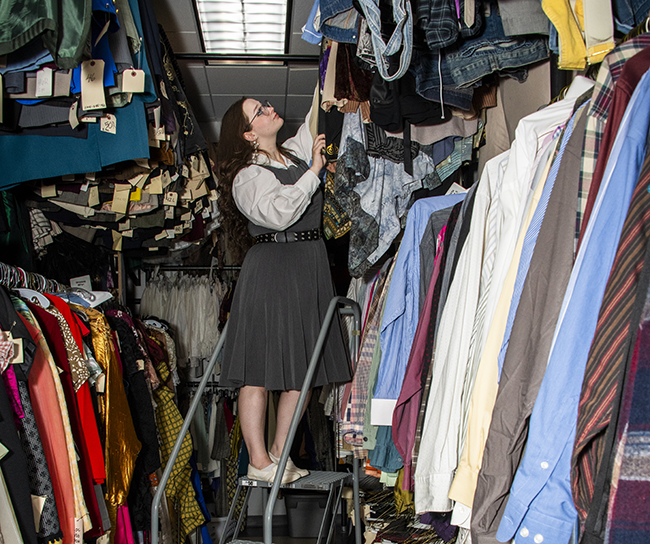
For someone whose first foray into theater was in the third grade and who first picked up a sewing kit at 13, costume design is, to Mark, a way he could meld his two loves together.
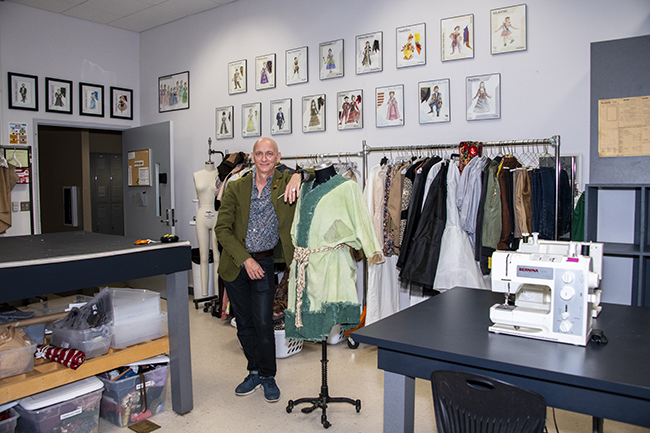
“Fashion is what I like to wear and what I want other people to wear,” he explains. “But when I’m a costume designer, it’s not what I want, it’s what the character wants. I like that about costuming — I can do something different all the time. In fashion you’re going to be designing basically the same concepts.” He gestures to some costumes on display in the shop today — Renaissance-era “Hamlet” to 1930s “Blithe Spirit” to outer-space-set “Fight Girl Battle World,” where the majority of characters aren’t even human. “You have so many different things you get to do in theater that you can never be bored,” Mark says.
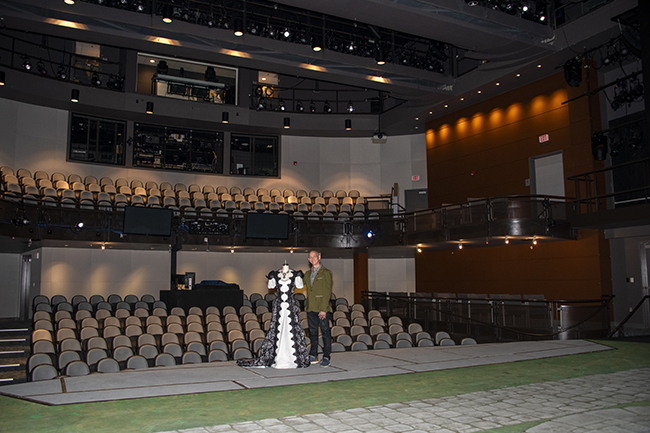
Not only does it matter where the character’s story is set in costuming, but the setting of the audience does as well. In his costume design classes, Mark speaks to the importance of considering the theater the performance will take place in. You can get away with different things in a smaller black box space than in a 3,000-seat theater like the one Mark worked at in Cincinnati. “For my first job there, I was pulling shoes for a production of ‘Traviata’ and I wanted to make sure the characters had dressier shoes with their tuxedos,” he starts. “The woman who worked there just kind of smiled at me and then when we got everyone on stage and I’m sitting in the audience I realized — I can’t even tell they have feet, let alone whether they’re in lace-ups versus a loafer.”
There are a lot of steps before Mark is getting to the feet of the matter, though. For each production, he starts out by reading the show and then meeting with the director to talk through conceptually what they’re thinking. After researching, he starts sketching out costumes to visualize what they’ll look like for each character. Next up is building the costumes, fittings and then dress rehearsals.
Mark and his students have about six weeks to get a show up, with the bulk of the costume-execution work happening in the shop with students. Mark will do the patterning, a shop supervisor will cut out the fabric needed, and then stitchers will come in to sew everything together. “I would say the design slash research portion I’m doing myself,” he says. “But I hire shop supervisors who I love being around and who are very talented on purpose because I am so much about bouncing ideas back and forth.”
Mark’s current shop supervisor, Kaitlyn Simmons, is co-designing “Cinderella” with Mark this upcoming February. Kaitlyn, who graduated in 2025, remembers getting a tour of the Cultural Arts Building on her first day of freshman year. “We walked into the costume shop and — you know how in cartoons when characters get heart eyes? — that’s probably exactly what happened to my eyeballs,” she says. Cut to years later, and she is right at home in the shop, confidently discussing her role as “Cinderella’s” co-designer. “It’s such a cool thing to build a show in your mind before anywhere else,” she says. “It’s just a fun, creative experience and to be able to do it with Mark, someone who has more experience than me, but we offer different perspectives and different backgrounds — to be able to bring those things together to make a show is so exciting.”
In addition to his work at UNCW, Mark serves as the assistant artistic director and costume designer for Opera Wilmington, the city’s first fully produced opera company. Founded in 2014, Opera Wilmington’s first production was “The Merry Widow.” That first production was a huge success, and the company has continued to grow and prove that Wilmington can support an opera company. Mark especially enjoys working on opera shows, saying that those costumes “can have a little bit more of a moment” in a show and that it is where he and the students “can really play” in design.
Mark describes the moment when a student “gets it” in class as his “favorite part” of the job. With graduates working on things like “Stranger Things” and “Scooby-Doo,” Mark says, “I love [the students’] creativity and being able to say that I had this little piece of helping them to where they are today.”
“I love all of it,” he adds after a beat. “I love designing, I love working with the opera, I love that I got to go back to theatre. Life is too short to not have a fun job.”